
For restaurants
A POS that knows a Pan 12" is not a Thin 12"
Pizzerias, burger joints, cafés, karahi and grill houses, fine dining and cloud kitchens. Sellify runs the floor, the pass and the phone — and tells you what every dish actually costs you.
The menu
Crust first, then size, then flavour
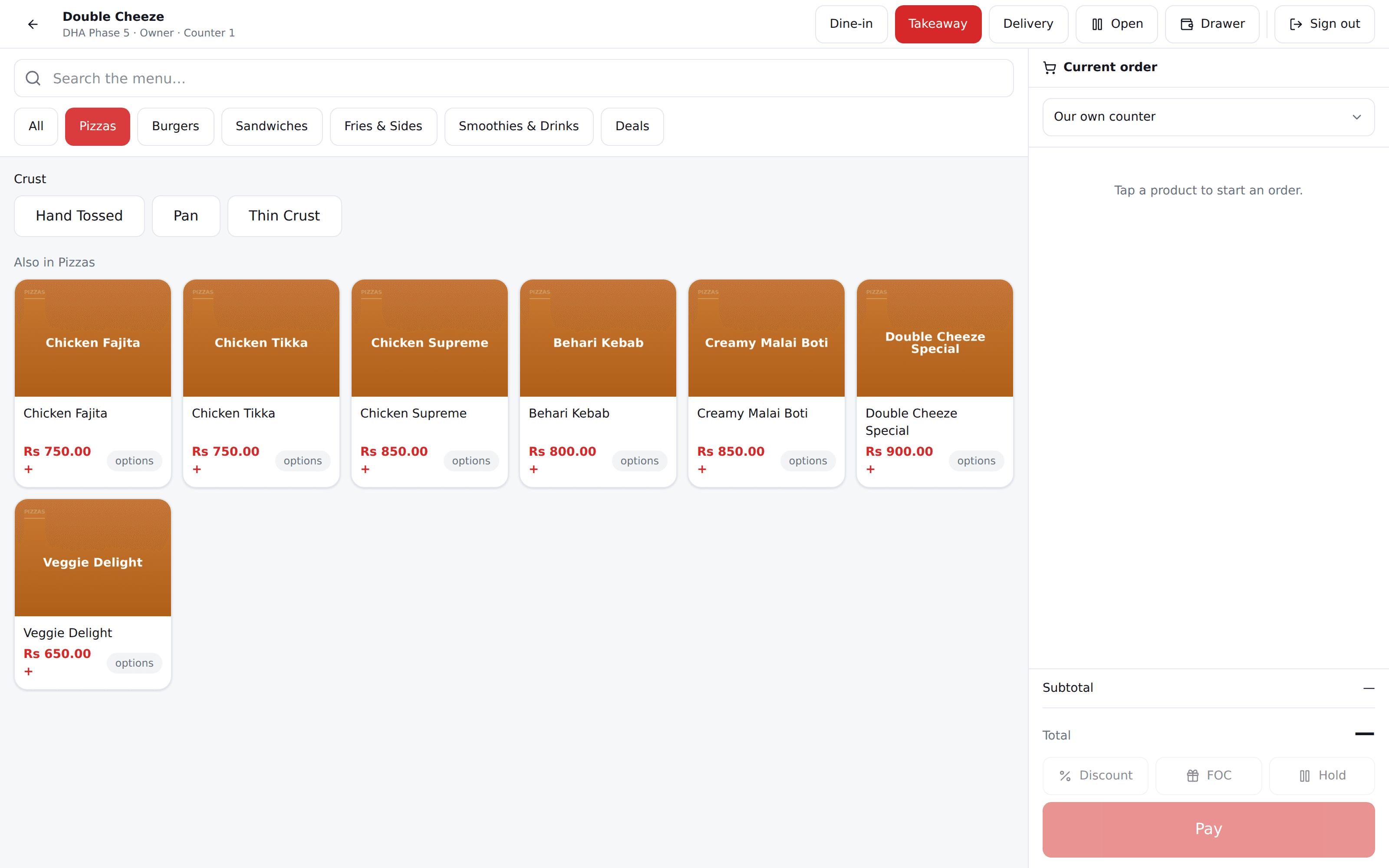
Three crusts across six flavours in three sizes is fifty-four buttons on most POS screens. On Sellify the cashier answers three questions, and only the combinations you actually make are offered.
A combination your kitchen does not make simply is not there — nothing is greyed out and nothing says "unavailable". Each cell names itself from what it is ("Pan · 12 inch"), so nobody types a variant name, and each carries its own shelf price and its own recipe.
Modifiers
Extra cheese costs the customer — and the shelf
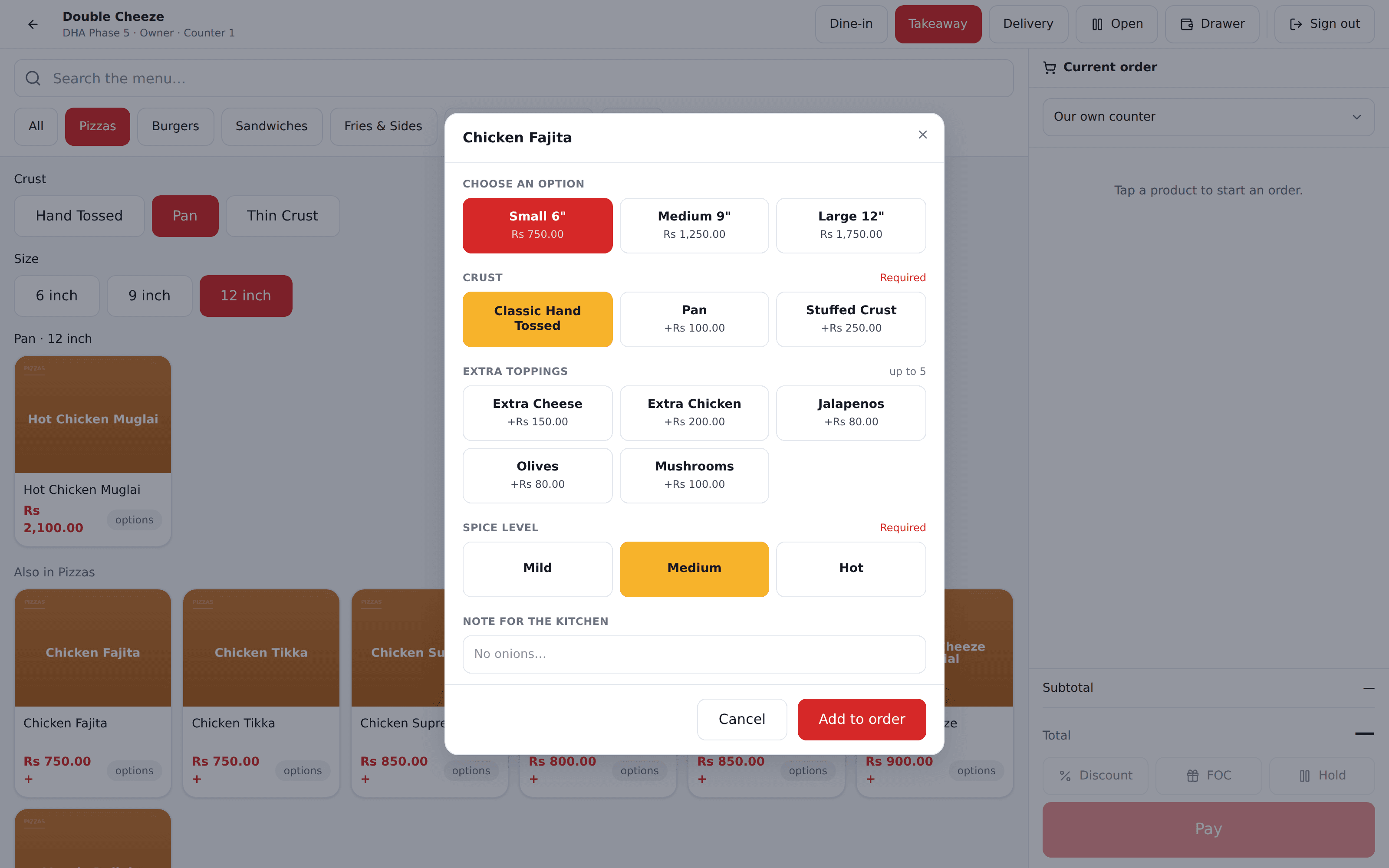
An option can carry its own ingredient list, so "extra cheese" charges the customer and takes 60g of cheese off the stock. Both of those change with the size, from one option rather than three.
Priced by size, offered by crust
Stuffed crust is priced by the size it goes on — one figure on a 9 inch, another on a 16 — and only appears on the crusts it can go on.
An option can be several things
Cheese by size, dough by crust, and a fixed 45g of chicken on all of them. Requirements add up rather than overwrite.
Prep items explode through their recipe
Dough never comes off a dough shelf — it becomes flour and oil, unless you keep it in batches, and then it is real stock.
The ticket remembers what was chosen
The kitchen slip, the receipt and the stock deduction all read the same snapshot. Changing a price tomorrow never rewrites today’s order.
Food cost
The one number most kitchens are guessing at
Write the recipe once, in grams and millilitres with wastage, and every sale takes ingredients off the shelf instead of taking a dish. Then read the same figures four ways.
Per dish
What each item on your menu costs to make against what you sell it for.
Per outlet, per day
Each branch costed on its own shelf, rolled up by city — outlets added together, then divided, never an average of averages.
Per stock category
Toppings, sauces, packaging — where the money is going before you look at any one item.
Against your count
What the sales should have used, against what your own stock count says is left.
A dish with no recipe is not costed at zero. Its sales are reported separately, because a food cost percentage that quietly reads low is worse than one that explains itself.
The pass
On a screen, on a roll, or both
Two independent switches per branch. A kitchen that reads a display needs no printer at all; a kitchen that has always used paper changes nothing.
A kitchen display, with no printer
Every order on the screen the moment it is placed, oldest first, amber then red as it waits. A cheap tablet on the wall is the whole hardware bill.
A tick per dish
A soup is ready before a biryani. On a dine-in card each dish has its own tick, so it goes out while it is hot rather than waiting for the table.
The waiter is told, with a sound
The moment a dish is ticked, the phone or till that punched it gets a Ready to collect strip and a chime. Tapping it is the pickup.
Told when the order is placed
Not when it is paid. A dine-in table that is held, a takeaway paid on the spot — the cooks care that the food was ordered.
One roll per department
Grill, bar, cold station. One combined ticket in sections, or one slip per department to its own printer — your choice, per branch.
Additions come through alone
Add a drink to a table already sent, and only the drink appears, marked ADDED TO ORDER so nobody starts the whole thing again.
Never any prices on it
A kitchen ticket with prices is a receipt somebody hands a customer by mistake. It says KITCHEN PRINT across the top instead.
Every detail of the dish
The variant its axes named, every modifier under the group it came from, every deal component, and the line’s note.
Printing never voids a sale
A printer that is off, jammed or unpaired says so on the same screen, with Try again beside it. The money is already recorded.
The floor and the phone
Dine-in, delivery, and the aggregators
One live bill per table
Punch a table that is already held and the till refuses it by name. Two bills on one table is two slips both headed TABLE 4.
Place first, pay later
A dine-in order is placed, the kitchen is told and the table is occupied. The bill is settled when they ask for it.
Deals answered at the till
“Any 9 inch pizza” is one rule that picks up a new flavour the day it goes on the menu. Upgrades are charged automatically.
A call centre desk
An agent takes the customer, the area and the cart, and the outlet is told within ten seconds. Nobody at a desk needs a cash drawer.
Riders and their cash
Out, delivered or failed with a reason. Each rider is settled against what they carried, and the day will not close with one still out.
Foodpanda, Bykea, your website
The order is rung on your till but never touches your drawer. Later, record what the platform actually paid and see the gap.
Your trade
Written for the kind of place you run
Cafés & coffee shops
Milk and shots that cost the shelf as well as the customer, one live bill per table, and a waiter on a phone.
Bakeries
Production, yield and wastage — what the bake actually gave you, and what was left at closing.
Kiryana & general stores
For the grocery shelf beside the kitchen: udhaar, barcodes and stock that keeps working offline.
Bring us your menu
Send us a photo of it. We will build your crusts, sizes, deals and modifiers before the call, so you are looking at your own shop rather than a demo restaurant.
No card needed. We set your company, your first branch and your login up in one go.